

Research and price check: 9 November 2026. Model access, benchmark results and API prices can change. Recheck current provider terms before procurement or production deployment.
Best LLM models in 2026: quick comparison
ChatGPT, Claude, Gemini, Grok, Kimi and DeepSeek are familiar product names, but they do not describe a single capability level. Each ecosystem now contains models optimized for different combinations of reasoning, speed, multimodal input, autonomous tool use and operating cost.
A frontier model can be justified for scientific reasoning or repository-scale software engineering, yet be wasteful for extracting fields from invoices. A smaller model may process millions of classifications economically but fail on an ambiguous multi-stage project. The comparison below is therefore workload-oriented, not a universal ranking.
| Developer | Model | Main strengths | Principal trade-offs |
|---|---|---|---|
| OpenAI | GPT-6 Astra | Frontier reasoning, coding and complex professional workflows | Premium API pricing and longer reasoning time |
| OpenAI | GPT-6.1 Sol | High-end coding and professional work with better economics | Less headroom than Astra on the hardest problems |
| OpenAI | GPT-6.1 Terra | Visual reasoning, computer use and efficient everyday work | Difficult architecture and science may require an upgrade |
| OpenAI | GPT-6 Luna | High-volume automation, routing and extraction | Less consistent on complex or ambiguous tasks |
| Anthropic | Claude Fable 5.1 | Deep reasoning, research and long-running agents | High cost and latency |
| Anthropic | Claude Opus 5.5 | Advanced coding, agentic workflows and knowledge work | Expensive for simple requests |
| Anthropic | Claude Sonnet 5.5 | Coding, writing and daily professional work | Less capability on the most difficult tasks |
| Gemini 4 Carbon | Frontier science, reasoning, coding and multimodality | Restricted rollout and substantial reasoning cost | |
| Gemini 3.8 Flash | Multimodal processing and production-oriented agents | Less headroom than frontier variants | |
| Moonshot AI | Kimi K3.1 Pro | Long-horizon coding, research and open-weight deployment | Demanding self-hosting and high reasoning latency |
| xAI | Grok 4.7 | Coding, tool use and analytical work | Not consistently dominant across all benchmarks |
| DeepSeek | DeepSeek V4.1 Flash | Efficient reasoning, coding and open-weight agents | Needs careful validation on demanding workflows |
Practical starting point: test GPT-6.1 Sol, Claude Sonnet or Opus 5.5, and Gemini 3.8 Flash on representative work. Add Astra, Fable or Gemini 4 only where additional capability creates a measurable benefit. Use Luna, Haiku or an efficient open-weight model for clear, high-volume tasks.
Understanding the AI model landscape
AI applications are not the same as AI models
ChatGPT is a product; GPT-6 Astra is a model. Claude can refer to Anthropic's assistant or to a model family whose Opus, Sonnet and Haiku tiers are materially different. The same distinction applies to Gemini, Grok and other services.
An application can combine a language model with live search, memory, code execution, file handling, image generation and external integrations. Two products using comparable base models may therefore produce different results. A fair evaluation separates the model's capability from the software around it.
Four broad LLM categories
Frontier reasoning
Maximum capability for scientific analysis, advanced coding and complex multidisciplinary work.
Balanced general purpose
Strong intelligence with manageable cost and latency for everyday professional workflows.
Lightweight and efficient
Fast, inexpensive execution for extraction, classification, routing and customer support.
Open-weight models
Deployment control, customization and private infrastructure, subject to license and hardware limits.
A fifth distinction is increasingly important: agentic capability. It describes how reliably a model plans, uses tools, interacts with software, recovers from errors and completes long sequences of work. The strongest conversational model is not necessarily the most reliable coding agent.
OpenAI GPT-6: Astra, Sol, Terra and Luna
OpenAI's sixth-generation lineup makes model choice a trade-off between intelligence, latency and cost rather than a simple version-number decision.
GPT-6 Astra: maximum capability
Astra is designed for sophisticated reasoning, software engineering, scientific problems and multi-step professional workflows. It is a strong candidate when a task requires research, code, files, software interaction and iterative verification. The trade-off is premium pricing and potentially substantial reasoning time.
Best suited for: complex engineering, scientific analysis, difficult business problems and sophisticated autonomous agents.
GPT-6.1 Sol: high-end intelligence with better economics
Sol aims to approach Astra-level performance on many demanding workloads at materially lower token prices. It is commercially attractive for development agents, technical research, document production and business automation where quality matters but flagship pricing cannot be justified for every request.
GPT-6.1 Terra: practical visual and computer work
Terra focuses on everyday intelligence, computer interaction and visual reasoning. It is useful for understanding screenshots, navigating interfaces, processing documents and making targeted code changes. Sol or Astra remains more appropriate for difficult software architecture or deep scientific work.
GPT-6 Luna: intelligence optimized for scale
Luna prioritizes speed and low cost. It fits structured extraction, request classification, short rewriting, ticket routing and other repeatable operations with clear success criteria. Ambiguous tasks and complex tool orchestration require a stronger model or escalation path.
Recommendation: begin with GPT-6.1 Sol for demanding professional workflows. Test Terra or Luna when latency and cost are priorities. Reserve Astra for cases where the additional capability measurably improves task completion.
Anthropic Claude: Fable, Opus, Sonnet and Haiku
Claude remains particularly relevant for coding, knowledge work, extended reasoning and autonomous agents. Its model tiers represent distinct capability and economic profiles.
Claude Fable 5.1
Fable targets the hardest knowledge-work and reasoning problems, including long-running coding projects, complex research and substantial professional deliverables. It can justify its higher cost when a representative test set shows a clear advantage over Opus.
Claude Opus 5.5
Opus is a serious model for repository-level software engineering, agentic coding, technical analysis and complex professional work. It can investigate failures and execute multi-step development tasks, but simpler requests are usually more economical on Sonnet.
Claude Sonnet 5.5 and Haiku 5.5
Sonnet balances performance, responsiveness and cost for coding, writing, technical documentation and routine agents. Haiku is optimized for fast, repetitive work such as extraction, summarization, routing and customer support; it can also serve as a subagent supporting a stronger model.
Recommendation: use Opus 5.5 as a starting point for complex development, Sonnet 5.5 for everyday professional work and Haiku for high-volume structured tasks. Test Fable when the workload exceeds Opus's practical ceiling.
Google Gemini: Flash, Argon and Carbon
Gemini's advantage extends beyond language. The family is built around text, images, audio, video, PDFs and integration with Google's wider AI infrastructure.
Gemini 4 Carbon and Argon
Carbon is Google's current frontier model for scientific reasoning, complex engineering and difficult multi-step problems. Argon focuses on advanced software engineering, mathematics, professional knowledge work and sustained execution. Both may consume substantial reasoning tokens, and phased access should be confirmed before planning a production deployment.
Gemini 3.8 Flash
Flash is a production-oriented model that combines multimodal input, coding, tool use and a one-million-token context window at a lower price than the frontier variants. It is especially relevant for applications processing large sets of documents, screenshots, audio, video and structured data.
Recommendation: consider Gemini 3.8 Flash for production systems. Evaluate Argon or Carbon when a difficult workload needs more reasoning capability and access is available.
Kimi, Grok, DeepSeek, Qwen, Meta, Mistral and GLM
Kimi K3.1 Pro
Moonshot AI's Kimi family combines long-context reasoning, agentic programming and downloadable weights. K3.1 Pro targets advanced coding, financial research and long-running tasks. Its scale makes independent deployment technically demanding, illustrating that open weights do not automatically produce low operating costs.
Grok 4.7
xAI's flagship supports configurable reasoning, a large context window, programming and agentic tool calling. Search integration can help with current information, but live retrieval is a product capability that must be enabled and tested rather than assumed to be part of the base model's knowledge.
DeepSeek V4 and V4.1 Flash
DeepSeek continues to emphasize efficient mixture-of-experts reasoning. V4 Pro targets higher-end coding and agent workflows, while V4.1 Flash prioritizes memory-efficient long-context inference, coding, automation and multimodal reasoning. It is a strong evaluation candidate when deployment flexibility and economics matter.
Qwen, Meta Muse, Mistral and Z.ai GLM
- Qwen3.8-Max targets multilingual, multimodal and long-context enterprise applications; Omni variants add stronger audio and video capabilities.
- Meta Muse Wonder emphasizes complex coding, subagent delegation, computer use and long-running software tasks, while Llama remains relevant for customization and broad deployment.
- Mistral Large 4 offers open-weight multimodal intelligence for coding and enterprise customization; Small 4 targets more efficient inference and routine automation.
- GLM-5.3 and GLM-5.3-Flash provide open-weight coding, tool use and efficient agent capabilities that should be validated against the exact production workload.
Which LLM is the most intelligent in 2026?
Independent benchmarks provide useful evidence, but not a universal answer. Artificial Analysis combines multiple evaluations across knowledge work, coding, science and general reasoning. The selected snapshot below uses high or maximum reasoning configurations.
| Model | Index score | Interpretation |
|---|---|---|
| Gemini 4 Carbon — High | 60 | Strongest selected overall composite result |
| Claude Opus 5.5 — Max | 59 | Especially strong in agentic coding and knowledge work |
| Gemini 4 Carbon — Medium | 58 | High capability at another reasoning setting |
| GPT-6 Astra — Max | 57 | Strong across science, coding and professional workflows |
| GPT-6.1 Sol — Max | 55 | Competitive high-end performance with better task economics |
Scores are index points, not percentages, and the ranking is a dated snapshot. Reasoning settings can materially change both score and cost. A model may lead on science but trail another in repository-level coding or document production. Methodology changes also mean results from different index versions should not be compared as if they measure identical tasks.
For business users, cost per successfully completed task is often more useful than benchmark position or price per token.
Best AI models by use case
These are starting points for a practical pilot, not guaranteed winners. Test the models with the same inputs, tools, reasoning settings and acceptance criteria.
| Task | Models worth testing | Why |
|---|---|---|
| Advanced scientific reasoning | Gemini 4 Carbon, GPT-6 Astra, Claude Fable 5.1 | Deep reasoning and sophisticated problem solving |
| Complex software engineering | Claude Opus 5.5, GPT-6 Astra, GPT-6.1 Sol | Strong coding and multi-step execution |
| Autonomous coding agents | Claude Opus 5.5, Kimi K3.1 Pro, Muse Wonder | Long-running development and tool use |
| Everyday programming | GPT-6.1 Terra, Claude Sonnet 5.5, Gemini 3.8 Flash | Good capability-efficiency balance |
| Deep research and analysis | Claude Fable 5.1, GPT-6 Astra, Gemini 4 Argon | Extended analysis and professional reasoning |
| Reports and presentations | GPT-6.1 Sol, Claude Opus 5.5, Gemini 3.8 Flash | Structured, multi-stage deliverables |
| Screenshots and interface automation | GPT-6.1 Terra, Gemini 3.8 Flash, Muse Wonder | Visual reasoning and computer interaction |
| Multimodal documents | Gemini 3.8 Flash, Qwen3.8-Max, GPT-6.1 Terra | PDF, image and structured-content understanding |
| Customer support | Claude Haiku 5.5, GPT-6 Luna | Fast, economical repetitive processing |
| Open-weight coding systems | Kimi K3.1 Pro, GLM-5.3, DeepSeek V4.1 Flash | Weight access and agentic capability |
| Cost-sensitive automation | GPT-6 Luna, DeepSeek V4.1 Flash, Mistral Small 4 | Efficient and scalable execution |
LLM API pricing comparison
The following standard API prices were verified as of 9 November 2026 and are shown in US dollars per one million tokens. They exclude infrastructure, provider markups, tool calls and other charges. Cached tokens, batch processing, large-context requests and reasoning settings may use different rates.
| Model | Input | Output |
|---|---|---|
| GPT-6 Astra | $10.00 | $50.00 |
| GPT-6.1 Sol | $2.00 | $10.00 |
| GPT-6.1 Terra | $1.00 | $5.00 |
| GPT-6 Luna | $0.10 | $0.50 |
| Claude Fable 5.1 | $10.00 | $50.00 |
| Claude Opus 5.5 | $4.00 | $20.00 |
| Claude Sonnet 5.5 | $2.00 | $10.00 |
| Claude Haiku 5.5 | From $0.10 | From $0.50 |
| Gemini 3.8 Flash | $0.75 | $3.75 |
| Gemini 4 Carbon | $2.00 promotional | $10.00 promotional |
| Grok 4.7 | $2.00 | $6.00 |
| Kimi K3.1 Pro | $2.00 | $10.00 |
| Mistral Large 4 | $0.70 | $2.10 |
Token price is only the beginning. A coding agent may search a large repository, execute code, revisit errors and generate substantial reasoning tokens. A cheaper model that needs repeated attempts can cost more than a premium model that succeeds immediately. Track retries, human review and tool expenses when calculating the cost of a completed task.
Open-weight vs proprietary LLMs
Advantages of managed proprietary models
Managed APIs reduce the need to operate specialized inference infrastructure. They provide access to advanced tools, ongoing model improvements and commercial support, making them the simplest starting point for many business applications.
Advantages of open-weight models
Open weights provide more control over deployment, optimization and customization, subject to the applicable license. They can be attractive for privacy, data residency, infrastructure independence and specialized workflows. Open-weight does not necessarily mean fully open source; commercial permissions and distribution rights differ.
Why self-hosting is not automatically cheaper
A moderate model may run economically on dedicated hardware. Models with hundreds of billions or trillions of parameters can require multi-GPU systems, quantization, specialized inference software and substantial memory. For many workloads, a managed API remains cheaper than independent operation.
How to choose the right LLM for a business project
1. Define the exact task
Start with the workflow the model must complete: generating product descriptions, analyzing financial spreadsheets, developing software, processing customer requests or conducting research. Avoid evaluating a general chatbot experience when the production job is narrowly defined.
2. Define the quality standard
Use objective criteria wherever possible. Coding agents should pass tests and produce maintainable code. Content systems should extract source facts without inventing claims. Research assistants should provide verifiable sources and distinguish evidence from interpretation.
3. Compare equivalent reasoning settings
Do not compare one model at maximum reasoning effort with another at its fastest setting and attribute the full difference to architecture. Reasoning depth affects quality, latency and cost.
4. Measure the whole workflow
| Metric | What it measures |
|---|---|
| Task success rate | Percentage of jobs completed correctly |
| Factual accuracy | Frequency of unsupported or incorrect claims |
| Latency | Time required to produce a useful result |
| Cost per completed task | Actual expense after reasoning, retries and tools |
| Tool-use reliability | Ability to interact with APIs, browsers and software |
| Instruction adherence | Ability to follow detailed requirements |
| Recovery behavior | Ability to detect and correct failures |
| Consistency | Reliability across repeated tests |
5. Consider a multi-model architecture
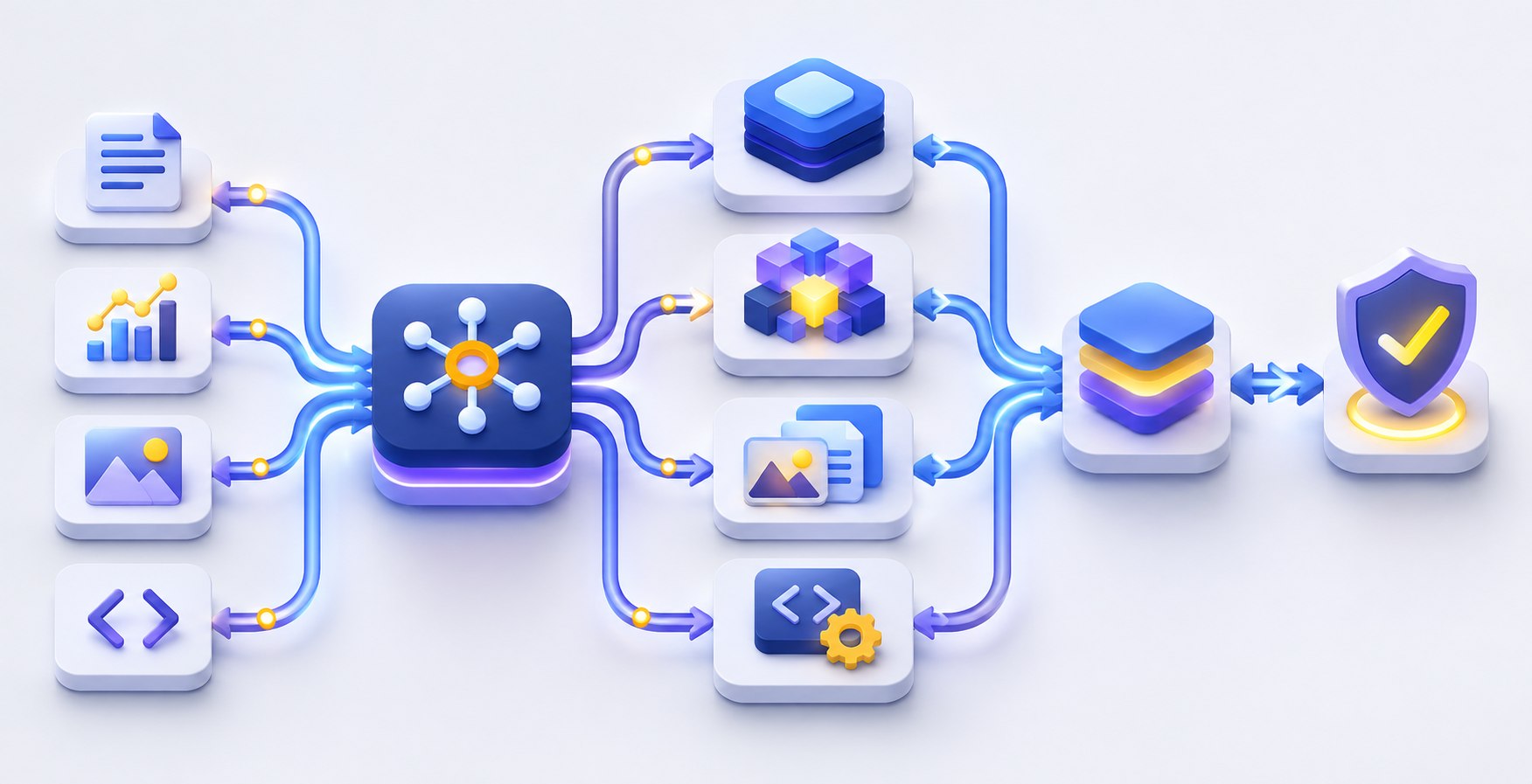
A content system might use a lightweight model for extraction, a stronger model for the final draft and a separate validation step. A development agent can delegate routine operations to a smaller model and escalate difficult problems. Routing can lower cost while preserving quality, but it adds orchestration complexity and should be adopted only when the benefit is measurable.
What changed between 2024 and 2026?
- Models moved from answering questions toward completing workflows with files, code, tools and verification.
- Providers replaced one flagship with specialized families for different capability and cost levels.
- Multimodal systems now process images, audio, video, PDFs and screenshots alongside text.
- Long-running agent performance, planning and error recovery became major competitive factors.
- Inference efficiency and useful performance per unit of compute matter more than parameter count alone.
- Businesses increasingly prioritize completed-task quality and cost over leaderboard position.
Frequently asked questions
What is the best overall LLM in 2026?
There is no universal best model. Gemini 4 Carbon leads the selected independent benchmark snapshot but has access restrictions. Claude Opus 5.5 and GPT-6 Astra are strong alternatives for demanding work, while GPT-6.1 Sol offers a different cost-performance balance. Choose according to the task, tools, availability, latency and budget.
Is Claude Fable 5.1 better than Claude Opus 5.5?
Fable offers additional capability for the hardest reasoning and long-horizon tasks. Opus is usually the more practical starting point for sophisticated coding and knowledge work because it provides strong performance at a lower price. Pay for Fable when testing demonstrates a clear advantage.
Is GPT-6 Astra better than GPT-6.1 Sol?
Astra has more capability headroom, but Sol is designed to deliver high-end professional performance at substantially lower API prices. For many coding and analysis tasks, Sol may be the better economic choice.
Which AI model is best for programming?
Claude Opus 5.5, GPT-6 Astra, GPT-6.1 Sol, Kimi K3.1 Pro and Muse Wonder are strong candidates. The correct choice depends on whether the workload involves snippets, debugging, repository refactoring or autonomous agent execution. Test representative codebases.
Are DeepSeek and Kimi as good as GPT and Claude?
They are credible competitors, especially for coding, agents and open-weight deployment, and may outperform proprietary alternatives on selected tasks. Results vary across evaluations, while leading proprietary systems retain advantages on some difficult workloads.
Which LLM should a beginner use?
Start with a balanced general-purpose model. GPT-6.1 Sol, Claude Sonnet 5.5 and Gemini 3.8 Flash are sensible candidates. The best interface and tool set for the user's actual work matters more than an isolated benchmark score.
Need Help Selecting an LLM for Your Business?
Pagecores can evaluate models against your real workflow, design a reliable multi-model architecture and connect it with automation.
Discuss Your Project
About the author
Pagecores Team creates practical AI solutions, web products, advertising systems and automation workflows for modern businesses.
View more Pagecores articles